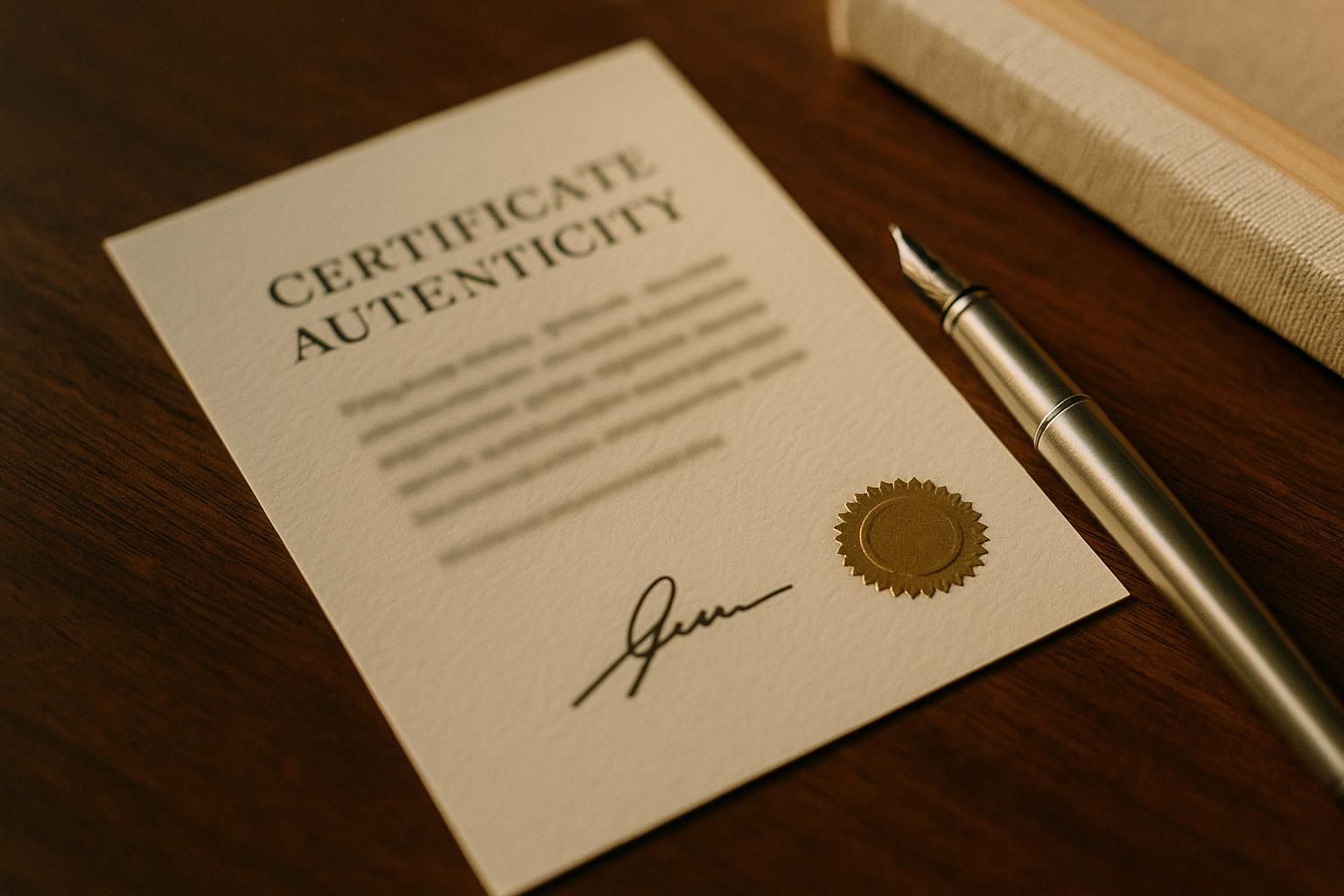
A Certificate of Authenticity (COA) is a piece of paper, usually card stock, that accompanies an original artwork. It's one of those things most buyers have heard of and very few fully understand. We think that should change.
Here's what a COA actually is, what it guarantees, and why it matters.
What it is
A COA is a signed, numbered document that identifies a specific artwork and attests to its authenticity. It's not a certificate of valuation (that's an appraisal). It's not a title deed (that's a bill of sale). It's a standalone document whose job is to say, on the authority of the people best positioned to say it: this piece is what we claim it is.
At Maestra, every original travels with a COA that lists:
- The piece's title, year, medium, and dimensions
- The artist's full name and signature
- A unique COA identifier tied to that specific piece
- The Maestra seal (a physical embossed mark)
- Whether the piece is the Primary Work of its composition or an Artist's Variant
What it guarantees
A good COA answers four questions:
- Is this piece real? Meaning: was it actually painted by the person whose name is on it, in the year and at the size claimed.
- Is it unique, or one of many? Bespoke and Original pieces are one-of-one. Artist's Variants (our Made to Size program) are hand-painted variations of an existing composition; the COA distinguishes them.
- Can its provenance be traced? The unique COA identifier is logged in our records. If the piece changes hands (insurance, loan, resale), the COA travels with it.
- Who vouches for it? On our COAs, two parties — the artist and Maestra — sign and seal.
What it doesn't guarantee
A COA is not:
- A valuation. It says nothing about what the piece is worth today or will be worth in ten years. That's an appraisal, and appraisals need to be refreshed every few years.
- A warranty on condition. A COA doesn't mean the painting will never fade or crack. It means the painting is what we say it is.
- A guarantee it was made in the artist's studio. For most of art history, "in the artist's studio" and "by the artist's hand" have been allowed to be loosely correlated. We're stricter than that — every piece with our COA was painted by the artist personally. But this is a contractual stance, not something the paper itself proves.
Why it matters, even if you never plan to sell
Most first-time buyers assume the COA matters mostly for resale. That's true, but it's not the main thing.
The COA matters because:
- Insurance. Your home insurer needs documentation for coverage above standard limits. A COA is the baseline document they'll ask for.
- Provenance for your children. If the piece is inherited, the COA is what turns "this was my mother's painting" into "this is a documented Yara Khoury, painted in Beirut in 2024, one of four works from her autumn sequence." That distinction matters.
- Confidence that the piece is what the artist made. For works bought direct from artists through any marketplace, the COA is the baseline proof that what you have is what was promised.
On the Primary Work / Artist's Variant distinction
We're one of the only marketplaces that formalises this. The Original of any composition is marked on its COA as the Primary Work — the one-of-one piece that came first, in a specific studio and moment. Any Made to Size versions painted later are marked as Artist's Variants, referencing the original composition.
Both are authentic, signed, one-of-one paintings by the same hand. Only the Original is the primary work, which is why collectors often treat it as more precious.
Look after it
Practical notes: keep the COA flat, with the piece if possible, away from direct light. When you frame the work, we recommend storing the COA in a small archival sleeve behind the back of the frame. Photograph it (both sides) and keep a digital copy with your insurance records.
A COA you've lost is a much bigger inconvenience than a COA you've kept.