We don't mark up framing. This is unusual in the art business, and worth explaining.
The standard model
The standard way to buy art online, and the way it's been for as long as art has been sold online, is that the gallery or marketplace offers to frame your piece before shipping. You select a frame from a small menu — black, white, natural wood, "float mount," etc. — and pay somewhere between $150 and $900 extra. The piece arrives framed, ready to hang.
This is convenient. It's also, almost always, worse than having the piece framed locally.
Why
Framing is architectural. A frame doesn't sit in isolation — it sits in a specific room, with specific trim, specific wall colour, specific surrounding furniture. A framer who has seen the piece but not the room is guessing. A framer who has seen both, who can walk you through the mouldings in their showroom, show you corner samples, compare warm walnut to cool oak against the light in your house — that framer will consistently do better work.
There is also the matter of cost. Most framing markups in the art industry run 30–60%. The framing work itself isn't cheaper; you just pay more for the same thing. Nobody tells you this.
What we do instead
We ship pieces rolled, in protective tubes, with full door-to-door insurance. The piece arrives un-stretched, un-framed, ready for you to take to a framer you trust.
We maintain a vetted framer network in about 40 cities globally — people we've worked with, whose taste we trust, whose craft is honest. If you'd like an introduction, we'll make one for free. You pay them directly, at their normal rates, with no markup added by us. If you already have a framer you like, use them. We genuinely don't mind.
The counterargument we take seriously
"I don't want to think about framing, I just want the piece to arrive ready to hang."
Fair. And if you really don't care about the frame, there's no right answer — framing is the part of the process you can skip if you want to. You can also stretch the canvas and hang it unframed, which is how a lot of serious collectors prefer their work anyway.
But in our experience, the people who think they don't care about the frame end up caring a lot, six months later, when they're living with a piece that looks almost right but has a small, nagging wrongness that turns out to be the frame.
Framing is one of those decisions where the cost of doing it well is low and the cost of doing it poorly compounds over years.
The specific thing a local framer can do that we can't
Let us show you what this looks like in practice.
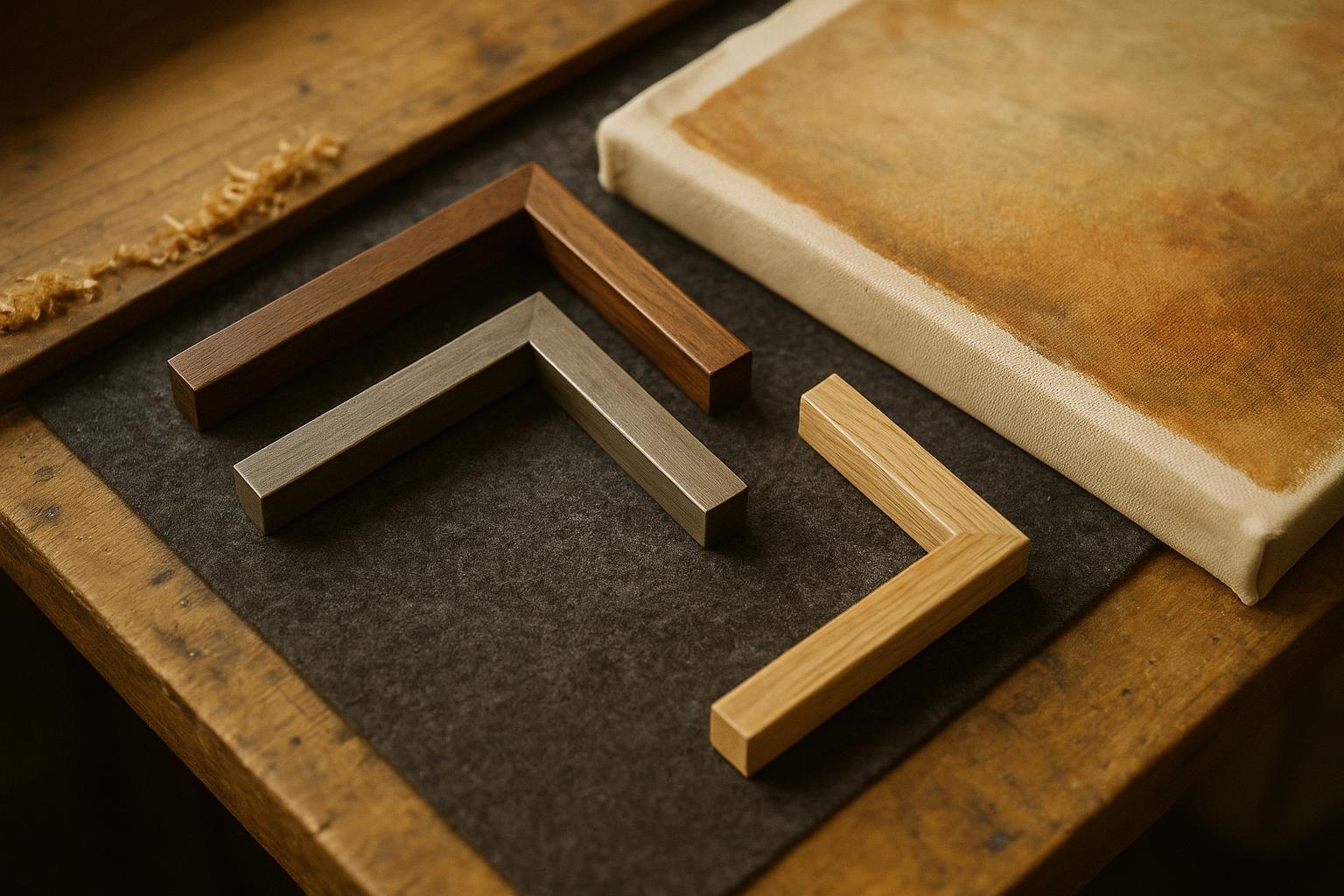
You buy a coastal oil painting. It arrives rolled. You take it to a framer in your city. They unroll it in their shop, hold three moulding samples against it — a warm walnut, a brushed pewter, a simple natural oak — and watch how each sits against the painting's palette.
You also bring a photo of your wall. The framer looks at the wall colour and the adjacent furniture.
Based on all of that, they recommend a specific frame. Maybe a recessed walnut with a linen liner. Maybe just a simple floating frame so the canvas edges show. Maybe, if the piece is the kind of painting that wants to breathe, no frame at all — just a good stretching job.
This is a 45-minute conversation that costs you nothing and saves you the next six months of looking at an almost-right frame. It's also a conversation no online form can replicate.
A short, practical guide
If you've bought an oil from us and aren't sure what to do next, here's the short version:
- Don't rush. Live with the rolled painting (safely stored) for a week while you think about framing.
- Find a framer, not a frame shop. Ask: do they have a real workshop, do they stretch canvas on-site, do they have 20+ moulding samples in real wood (not photographs of wood)? Chain framing stores aren't the same as a real framer.
- Bring the painting to them, not the other way around. If they want to send you photos of samples over email, that's a signal to find someone else.
- Expect to spend 10–25% of what you spent on the piece on framing. A $3,000 painting usually lands at $300–$600 framing, well-done. More is fine if the piece warrants it. Less is fine if the frame is simple.
- Email us and we'll make an introduction. If you'd rather not hunt, we have framers we trust in most major cities.
The frame is the handshake between the painting and the room it lives in. It deserves a good one.