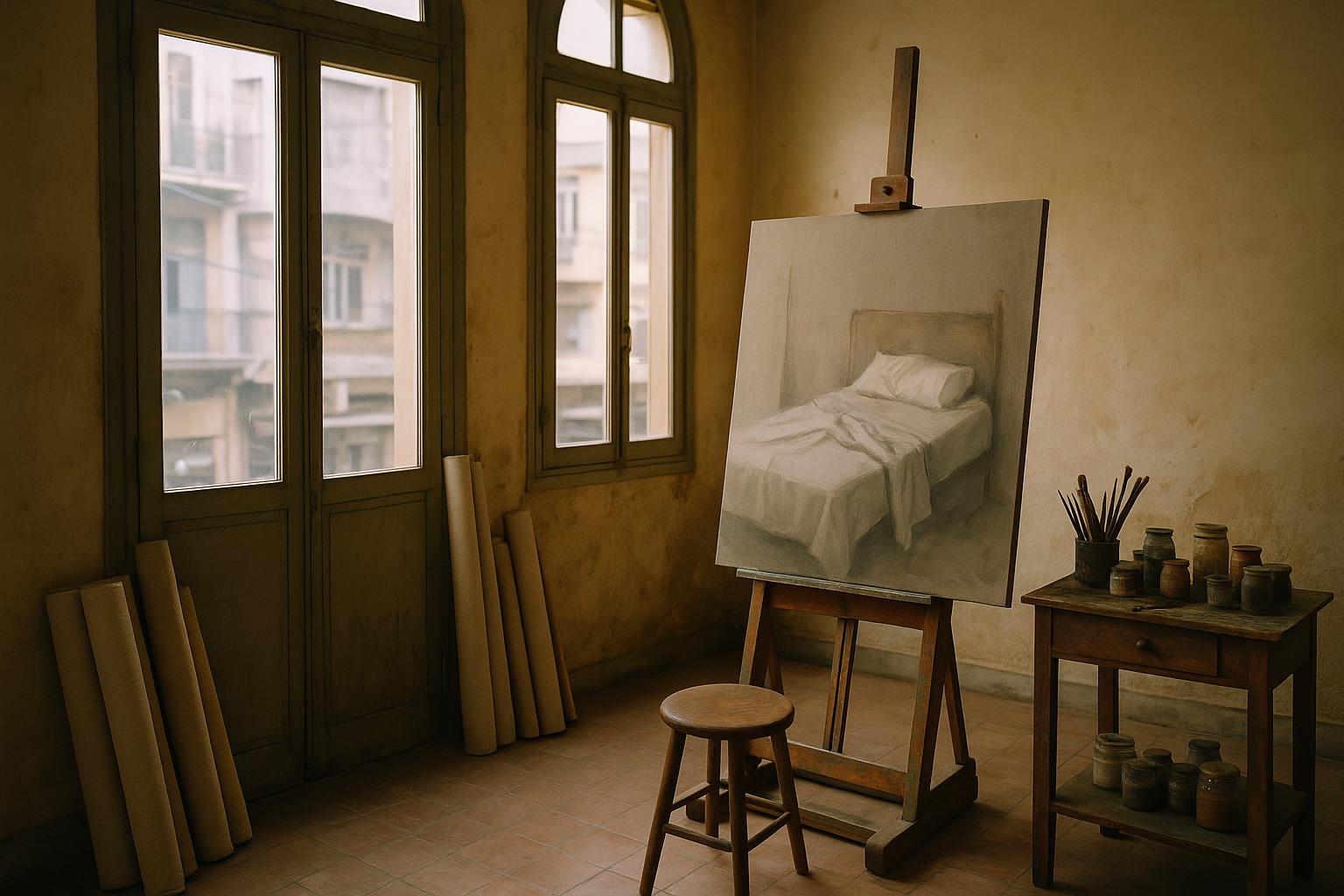
There is a specific flight of stairs you climb to reach Yara's studio. It begins above a carpet shop in Mar Mikhael, a neighbourhood in Beirut that, depending on the year you're asking about, has been either the most fashionable or the most damaged part of the city. The stairs smell like turpentine before you reach the top.
Yara has been painting in this room for almost eleven years. The space is small — maybe 400 square feet — with two tall windows that face north. The north-facing light was non-negotiable, she'll tell you. She made that decision in her first month as a painter and has never worked in a space without it since.
"Painters talk about light like it's a preference," she says. "It's not a preference. It's a condition of the job."
What she paints
Yara's work is figurative, though she resists the word. She paints rooms more often than people — rooms just after people have left them. A sheet pushed aside at 7:30 in the morning, still holding the shape of the body. A cup on a table with the handle still turned toward where a hand reached for it. A door opened partway.
"I paint what stays," she says. "Not the person. What the person leaves in a room when they walk out of it."
This is harder to do than it sounds. A painting of an empty room has to carry the emotional weight of the body that was just there. Most painters who try it end up with what she calls "postcards" — rooms that are pretty but empty of meaning. Yara's rooms are not empty. They have someone in them, even though there's no one in them.
The critical machinery that would normally unpack this kind of work has mostly passed her over — she doesn't show in New York or London, doesn't have a dealer, doesn't chase fairs. Her collectors find her slowly, usually through word of mouth, and most of them own only one of her pieces because most of them can only afford one. She is fine with this.
How she works
Yara paints in oil on linen, which she stretches herself in the far corner of the studio. She grinds her own whites from lead — a technique she learned from her father, who was a restorer — and buys everything else from a supplier in Athens she's been using for nine years.
She works on one painting at a time. This is unusual; most painters keep three or four pieces going so they can rotate while things dry. Yara finds that distracting.
"A painting is a conversation," she says. "You can't have three at once. Or — you can, but nothing is said."
A piece takes her, on average, five to seven weeks. She paints six days a week, roughly eight hours at a stretch, and takes Sundays off to walk in the old city. She does not discuss her work on the days she's not in the studio, because — her phrase — "talking about a painting is a way of avoiding it."
Why Maestra works with her
We met Yara through one of the best painters we know, who told us she was the real thing. Everything since has confirmed it. She is careful with her collectors, honest about timelines, and better than almost anyone at capturing the kind of quiet her buyers are actually looking for.
Yara accepts bespoke commissions on a rolling basis, usually no more than four or five a year. Her work tends to find collectors who live with it for decades.
If you think your wall has been waiting for a Yara, it probably has.