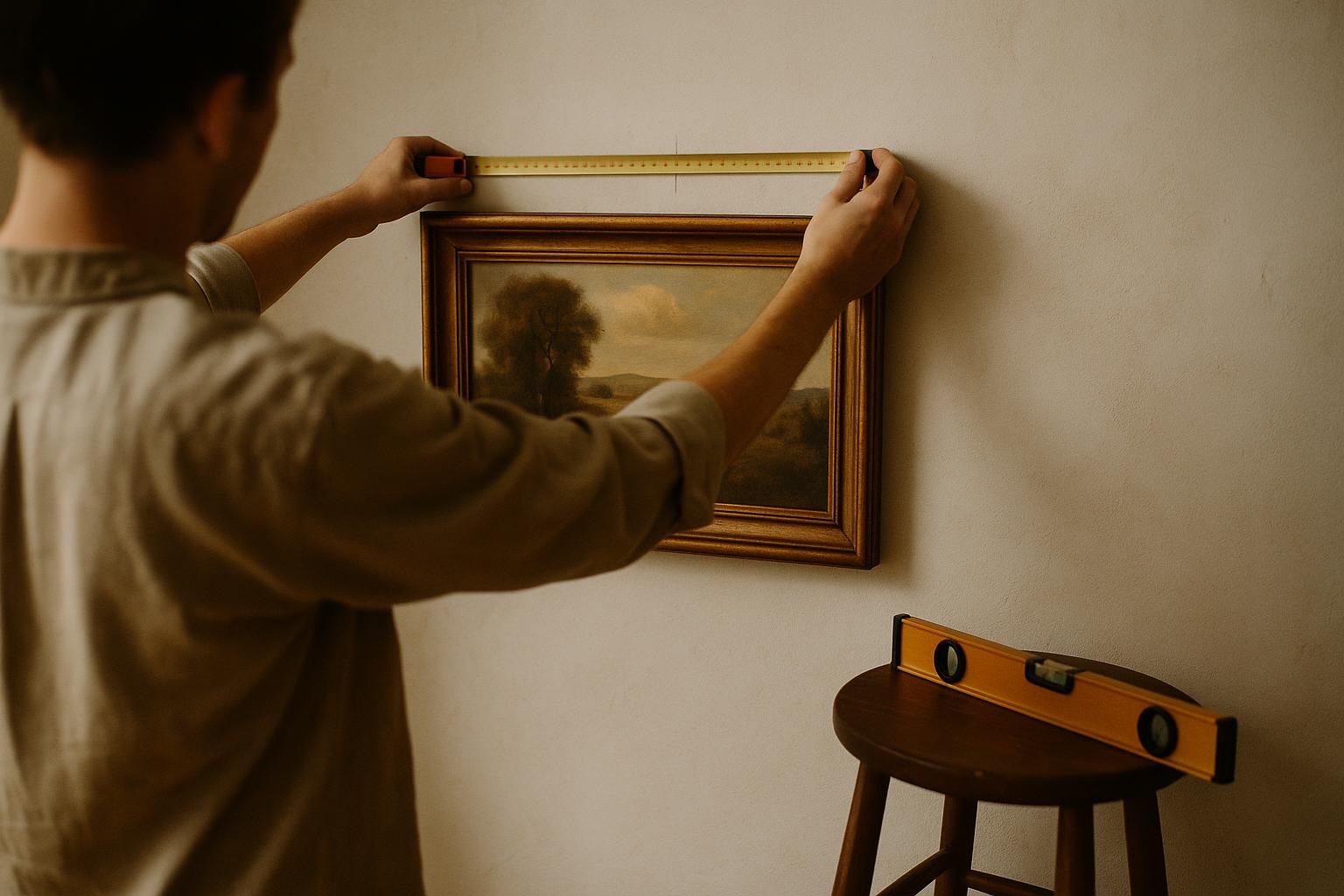
There is a rule most people half-remember about hanging art, which is "hang it at eye level." This is, depending on who wrote the rule, either helpful, wrong, or actively misleading.
Here's a better guide.
The rule that matters: the centre of the piece should be at 57 inches
Museum conservators use 57 inches (145cm) as a standard centre height, because it roughly approximates average human eye level across standing adults of typical height. This is the right number for most hangs in most rooms.
Not 60. Not "eye level." 57.
Get a tape measure. The centre of the painting (not the top, not the hanging hook) should be 57 inches from the floor. This is the single most impactful change you can make to how a piece of art feels in a room.
When to break the rule
You break 57" when:
- The piece is over a piece of furniture. The painting should relate to the furniture below it, not float above it in isolation. The bottom of the painting should be 6–10 inches above the top of the sofa/console/mantel. If that puts the centre above or below 57", follow the furniture.
- You have high ceilings. In a room with 12-foot+ ceilings, a 57" centre can look lost. Consider moving the centre up to 62–65".
- You're in a gallery wall. Gallery walls have their own logic, which we'll cover in another piece. Short version: the perceived centre of the whole arrangement should be at ~57", not any single piece.
- You're hanging a landscape above a bed. Beds are odd. Follow the furniture rule — 6–10 inches above the headboard — even if the centre ends up high.
Lighting
An oil painting needs light. A painting hung in the shadow of a doorway or a recessed wall will read as dark, flat, and un-special even if it's a great piece.
Ideal: natural light that reaches the wall at an angle, especially morning or late-afternoon sun. Second best: a picture light mounted above the piece, set to warm white (2700K). Avoid: direct downlights directly above the painting (they create unflattering top-lit shadows), or any light that reflects off the painting's surface into the viewer's eyes.
Oil paintings in particular do something specific in warm, angled light — you can see the brush marks, the paint weight, the way pigment catches. That's half the point of buying an oil. Give it the light to do its job.
Spacing between pieces
If you're hanging two or more pieces next to each other, a good default is 2–3 inches of space between frames. Too little looks crowded; too much makes them feel unrelated.
For a pair with the same dimensions, align the centres. For mismatched pieces, align either the top edges or the bottom edges — pick one and commit.
Hanging hardware
For oils on stretched canvas: two D-rings on the back, 2/3 of the way up, with picture wire strung between them. This gives you the ability to adjust left/right slightly after hanging.
For larger pieces (over 24×36"): use two hooks on the wall, separated by about a third of the piece's width. Two hooks make the piece sit square and stop it from drifting.
For real weight: don't rely on drywall anchors alone. For pieces over 15 lbs, find a stud, or use two heavy-duty toggle bolts.
Framing
A quick note: we ship rolled, and most of our pieces come unframed. Framing choices are personal and local — we recommend using a framer you trust, in the city where the piece lives, rather than shipping it out and back for framing. We don't mark up framing; we can connect you to framers in most major cities if you'd like a recommendation.
A well-hung unframed canvas, in the right light, often looks better than a badly-framed one. Don't rush the frame.
Finally: live with it for a week before you commit
Use painter's tape to mark the intended frame outline on the wall before you hammer anything. Live with the outline for a few days. You'll often find yourself wanting to shift it an inch one way or the other — and that inch will be the difference between a painting that feels right and one that feels almost-right.
An inch matters. So does a week.